Choose F-150 oil using the exact model year, engine and Ford specification in the US owner's manual. Engine displacement, turbocharging, hybrid equipment and performance variants can matter, so the F-150 name alone is not enough.
Ford F-150
Model-family oil and maintenance guidance.

F-150 oil specification — what to confirm
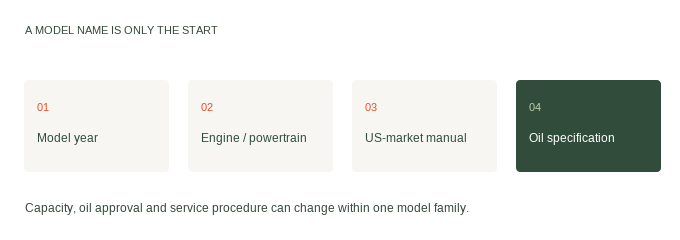
A single truck generation may offer several engines, and used trucks can carry replacement parts. Verify the engine from the VIN-linked records and manual, then read the oil specification table and its footnotes. Record the Ford performance specification along with the viscosity. A container labeled for trucks or turbo engines does not prove that it meets the required application.
Verified example: 2024 F-150 2.7L EcoBoost
The US 2024 F-150 manual lists SAE 5W-30 meeting Ford WSS-M2C961-A1 for the 2.7L EcoBoost, with 6.0 US qt (5.7 L) including the filter. This is an engine-specific example, not a specification for every F-150. The same manual gives the 5.2L a different oil and quantity, illustrating why the engine must be identified. Finish with the prescribed level check.
A practical way to handle it
Compare the bottle or manufacturer data sheet with both parts of the requirement. For a full service, confirm the correct oil-and-filter quantity and filter part application. For top-ups, measure the existing level first rather than using the capacity figure. Keep the purchased oil's full product name on the receipt so future services can be checked against a known record.
Mistakes to avoid
Do not use a towing discussion or an aftermarket tune as automatic permission to substitute a thicker grade. If the truck is modified, obtain the relevant written technical advice and understand how it relates to the original instructions. A broad internet capacity chart can mix engines and should never override the actual vehicle documentation.
Your working checklist
- Identify year, engine and any powertrain variant.
- Write down viscosity and Ford specification.
- Check filter fitment and service-fill quantity.
- Record the actual lubricant used.
Common questions
Will oil recommended for one F-150 V8 fit every F-150?
No. An engine family and model year define the requirement. Turbocharged, hybrid, diesel and performance applications must be checked individually rather than grouped under one truck badge.
Does a Ford specification replace the viscosity requirement?
Read them together. A specification describes performance requirements, while the manual also identifies viscosity and any operating-condition alternatives. Match the complete instruction rather than treating either part as optional.