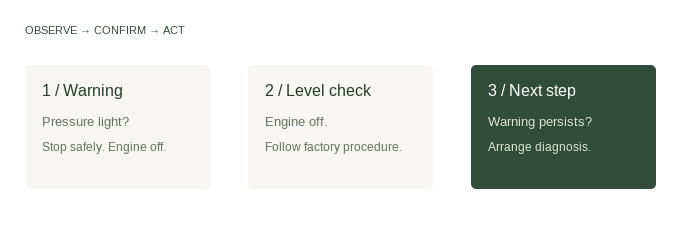
A sensor or wiring fault can cause an oil-pressure warning, but that explanation must be verified. Treat an unexplained warning while running as a reason to stop safely and switch off. A normal oil level or quiet engine does not prove that the sensor is the only problem.

Keep observation and diagnosis separate
Record the message, dashboard gauge behavior, engine temperature, and operating conditions. A stored fault code can guide investigation but does not necessarily prove the replaceable sensor is defective. Electrical connections, wiring, the measurement circuit, and actual lubrication pressure may all need consideration. Do not erase codes before the workshop inspects the vehicle, and do not unplug the sensor to make the warning disappear.
Verify the basics after shutdown
Check the oil level using the manual and review recent oil and filter details. Note any leak, contamination, or new noise. If the warning began after another repair, tell the technician which areas were disturbed. Avoid repeatedly restarting the engine to compare readings. The first task is to establish whether it is safe to run for a controlled test, not to keep driving until another symptom confirms the problem.
Request a test that answers the pressure question
A qualified technician can decide whether to measure actual pressure using suitable equipment and compare it with engine-specific requirements. It can then assess the indication circuit as appropriate. Ask for the test conditions and findings in understandable terms. Replacing a sensor may be correct when supported by evidence, but a parts swap without confirming the pressure concern can leave a real supply fault unresolved. Keep the original sensor or photographs if the repairer considers them useful for documenting the fault.
- Save fault codes and exact warning text.
- Do not bypass or disconnect the warning.
- Verify level and service product details.
- Use engine-specific test specifications.
Ask what evidence separates the sensor from real pressure loss
A pressure-related diagnostic code or an intermittent lamp identifies a system that needs investigation. It does not, by itself, prove that replacing the sender will repair the problem. Save the exact code and warning wording, when it occurs, and the oil-level observation obtained under the correct checking conditions.
Ask the technician which application-specific checks distinguish an electrical signal fault from actual pressure loss and what measurement conditions were used. A receipt that records the finding is more useful than a parts replacement list alone. Do not unplug a sender, reset a code or substitute a different warning threshold to make the symptom disappear. Until the pressure question is resolved, a running-engine pressure warning should be treated as a reason to stop safely and switch the engine off.
Ask what evidence separates the sensor from real pressure loss
A sensor or circuit code is present
Retain the code and request diagnosis that distinguishes signal failure from pressure loss.
The pressure lamp appears while running
Stop safely and switch off regardless of an assumed sensor explanation.
A replacement is proposed without a documented finding
Ask what test established that the proposed part is responsible.
Common questions
Can a bad sensor leak oil too?
Some pressure-sensing components connect to the oil system. Any suspected leakage needs inspection of the exact design.
Is it safe if the engine sounds normal?
Noise absence does not establish adequate lubrication pressure. Resolve the warning before normal operation.