The crankcase-ventilation system is one possible contributor to oil leakage or consumption, but its design varies widely. A loose hose or replaceable valve is not the whole system on every engine. Use an engine-specific inspection rather than assuming a generic PCV swap will fix oil loss.

Understand the diagnostic role
The system manages crankcase vapors as part of the engine's design. A fault can be relevant when oil appears in intake plumbing, leaks recur, or consumption changes. Those symptoms can also have other causes, so begin with a repeatable level log and a leak inspection. Record idle changes, fault codes, recent hose or cover work, and whether the issue began suddenly. Do not identify a failed valve from oil-cap suction alone.
Check accessible parts safely
With the engine off and cool, look for visibly disconnected, cracked, or incorrectly routed accessible hoses. Do not pinch or block a running ventilation line as a home test, and do not remove a cap or dipstick to judge pressure without a proper procedure. Some engines integrate separators or regulation components into covers or assemblies. Parts selection should match the exact engine rather than a universal fitting or an internet diagram of another model.
Ask for a complete cause-based repair
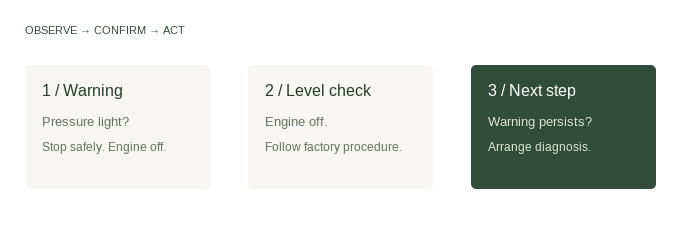
A technician can use the appropriate pressure or functional tests and assess related intake and oil-leak evidence. Ask which measured findings support the diagnosis and whether other faults could have caused or accompanied it. After repair, continue the level log long enough to confirm a stable trend and inspect cleaned leak areas. A pressure warning, heavy smoke, or rapid oil loss remains urgent even if a ventilation fault is suspected.
- Record consumption and external leaks separately.
- Use the exact engine's ventilation layout.
- Do not block hoses as a test.
- Verify the trend after repair.
Common questions
Can I replace a PCV valve on every car?
Some designs have a separate serviceable valve; others integrate the function into a larger assembly.
Does removing the oil cap prove a problem?
No. A casual cap test cannot substitute for the correct engine-specific procedure.