A fan that is stopped during one observation is not automatically faulty. Diagnose whether the system is commanding the fan, then check the supported electrical and mechanical path.

Keep clear of the fan assembly
Electric cooling fans can operate unexpectedly, including under conditions that are not obvious from the driver’s seat. Keep hands, clothing and tools out of the shroud and away from belts. Do not reach in to spin a blade or clear debris while the system can activate.
If the engine is overheating, respond to the warning before investigating the fan. Do not run an overheating engine solely to wait for the fan to start. Record the warning, conditions and any recent repair work, then allow the system to reach a safe inspection state.
Separate a command problem from a motor problem
Fan behavior can depend on temperature, A/C requests, operating mode and vehicle-specific controls. Some systems use multiple speeds or more than one fan. A brief visual observation therefore does not establish whether the motor, fuse, relay, control module, sensor signal or wiring is responsible.
Start with the correct system diagram and diagnostic information. A workshop can compare commanded operation with actual response and test the relevant circuit. Do not replace a fuse with a higher rating, bridge random terminals or apply battery power without a supported procedure and suitable equipment.
Look at the whole cooling complaint
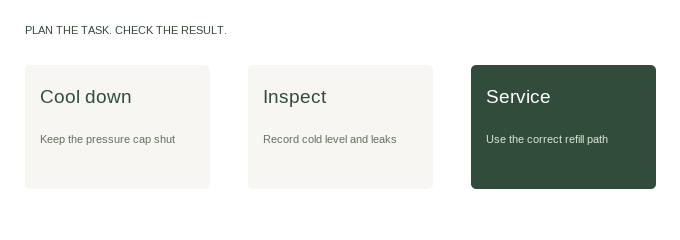
A working fan cannot compensate for every coolant leak, airflow obstruction or circulation fault. Note whether the cold coolant level changes, whether the radiator area is blocked and whether the symptom occurs at low or high road speed. These observations help keep a fan concern connected to the actual overheating complaint.
After repair, confirm that the original conditions were tested and that no warning returned. If a new fan was installed, ask whether the control and wiring fault was also resolved where needed. Keep part and test details with the service record so a recurring problem can be investigated from a useful starting point.
Separate the diagnostic questions
| Question | What it establishes |
|---|---|
| Is fan operation requested? | Control-side expectation |
| Does the circuit supply the required operation? | Electrical-path response |
| Does the fan move correctly? | Motor and mechanical response |
| Does temperature stay controlled? | Result under the original conditions |
Common questions
Should the fan always run when the A/C is selected?
Control strategies vary. Use the system’s actual command and operating conditions to evaluate the response.
Is a higher-rated fuse a solution?
No. An incorrect fuse rating can defeat circuit protection. Find the reason the specified circuit is failing.
