A spin-on filter replaces a sealed canister; a cartridge system replaces the element inside a reusable housing. The engine determines the type. Neither design removes the need for correct fitment, sealing and the specified tightening procedure.

Recognize the two service arrangements
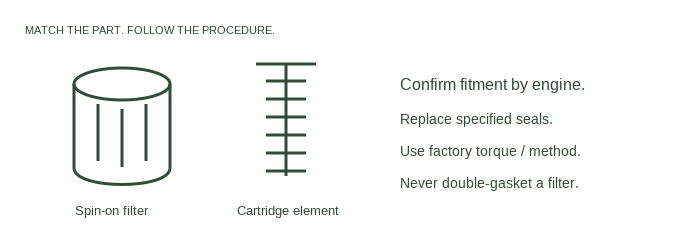
A spin-on filter includes its outer canister and mounting gasket. A cartridge element sits inside a housing closed by a cap, often with replaceable O-rings. Do not buy from appearance alone: cartridge dimensions and end fittings, or spin-on application features, can differ between apparently similar parts.
Understand spin-on installation
Remove the old filter and confirm its gasket is not stuck to the mounting face. Clean the surface and follow the new filter’s gasket-lubrication and tightening instructions. A removal wrench is not permission to overtighten installation. Check the product’s printed instructions instead of applying a universal turn count.
Understand cartridge installation
Identify every specified O-ring and its correct groove. A ring placed on a nearby thread or shoulder can fail even when the cap seems tight. Inspect the cap and housing for damage, fit the element as directed and use the required torque. A plastic cap can be damaged by an ill-fitting tool or excessive force.
- Verify element or canister part number.
- Compare supplied seals with the service instructions.
- Start threads carefully by hand.
- Check for leaks and remeasure the level.
Do not convert by improvisation
Changing filter design requires an engineered, application-specific system rather than a casual parts substitution. For ordinary maintenance, use the intended arrangement and correct replacement parts. If a reusable housing is damaged, repair it appropriately; a new element alone cannot fix a broken cap, damaged thread or sealing surface.
Make the parts list match the service arrangement
A spin-on canister and a cartridge element organize the service differently. Identify the installed arrangement before ordering tools or sealing parts. A vehicle-name match on a retail page is less useful than the correct engine application, current part identification and the seals required for that housing.
Inspect the removed arrangement as part of the supported procedure. Keep an old gasket from remaining on a sealing face and place replacement housing seals in their specified grooves. Record the actual part and seals installed; the exterior appearance of a filter alone does not establish compatibility or filtering performance.
Compare the service details
| Arrangement | Preparation check |
|---|---|
| Spin-on canister | Correct canister, gasket and removal tool |
| Cartridge element | Correct element, housing tool and replacement seals |
| Either type | Application, sealing surface and installation method verified |
Common questions
Is one type always better?
The service quality and correct application matter. The engine is designed around its installed system.
Can I reuse the cartridge O-ring?
Replace seals when specified and use the supplied correct parts. Do not reuse damaged or unsuitable seals.
