0W-30 and 5W-30 share an SAE 30 high-temperature grade and have different cold classifications. Their manufacturer approvals can also differ substantially. Use the grade and complete specification required for your engine rather than assuming all 30-grade synthetics are equivalent.

Look beyond the similar numbers
The viscosity grade describes one part of oil performance. Products carrying the same high-temperature grade can be formulated for different engines and exhaust-treatment systems. A European approval, API category or ACEA claim may matter as much as the large numbers on the front label.
Match the manufacturer’s approval wording
Read the exact approval code in the manual and compare it with the current product data. Do not shorten a code or assume a related-looking approval is interchangeable. If both grades are permitted, select a product meeting the complete requirement and any stated temperature or service-condition restrictions.
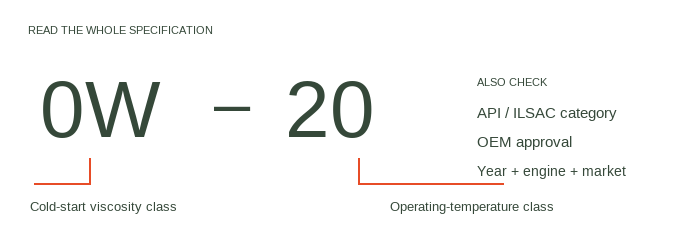
Separate cold-weather claims from engine permission
A lower W classification concerns low-temperature performance, but it does not automatically make an oil suitable for every engine in a cold region. The correct formulation and approval still matter. Likewise, a 5W-30 bottle sold as full synthetic is not necessarily the same application as an approved 0W-30.
- Write down the full approval code.
- Check the exact viscosity variant.
- Read permitted alternatives in the manual.
- Avoid changing interval based only on a premium label.
Resolve a shelf-level decision
When two products look similar, compare their data sheets side by side for the required approval. If one lacks it, that is enough to stop treating them as equivalent. Ask the manufacturer or oil supplier when the claim is ambiguous. Keep a record of the selected product so future top-ups remain consistent.
Common questions
Is 0W-30 always better in winter?
It has a different cold classification, but engine suitability still depends on the complete requirement.
Can two 5W-30 oils be different?
Yes. Viscosity alone does not establish identical approvals or applications.
What record helps when buying a future top-up?
Keep the complete required approval and preferred grade, plus a photo of the product used. That gives another buyer enough information to check suitability instead of matching only the brand name.