Both oils share an SAE 30 high-temperature grade, while their low-temperature classifications differ. Choose within the manufacturer’s allowed grades and temperature guidance, and match the full performance specification. The shared 30 does not prove application compatibility.

Understand the limited comparison
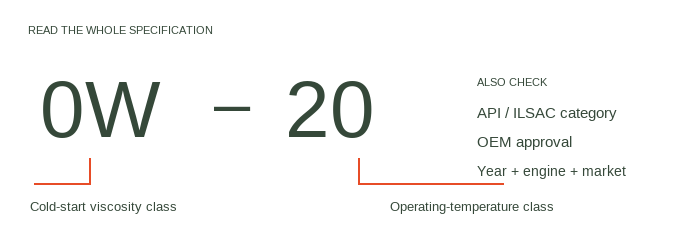
The grade label describes classified viscosity performance, not every chemical or operating characteristic. A 5W-30 and 10W-30 may have different approvals, base-oil formulations and intended applications. Comparing only the second number can hide the differences that matter for a particular engine.
Use permitted temperature charts correctly
An older manual may show several grades against ambient-temperature ranges. Apply the chart for the exact engine and market and retain any accompanying performance requirement. Do not borrow a chart from another vehicle or assume that warmer weather authorizes any oil with a higher W number.
Do not treat 10W-30 as a high-mileage repair
A different cold classification is not a substitute for diagnosing consumption, leaks or starting concerns. Mileage alone does not rewrite the specification. If an engine has been rebuilt or modified, obtain written guidance from the responsible engine builder rather than improvising from a generic viscosity comparison.
- Read the complete grade allowance.
- Match API, ACEA or manufacturer requirements.
- Check exact product data, not just the front label.
- Retain the correct service interval.
Make top-up choices deliberately
Carry a product meeting the preferred requirement where practical. If it is unavailable, read the manual’s substitution guidance rather than assuming all SAE 30 oils are equivalent. Record what was added and ask about any follow-up service requirement. A blend of two grades does not have a formally verified new grade you can calculate at home.
Common questions
Does 10W-30 stay thicker when hot than 5W-30?
They share the same high-temperature grade classification; actual product properties can differ within it.
Can I use 10W-30 in any older car?
No. Older engines still have specific requirements and permitted temperature guidance.
Can both grades be conventional or synthetic?
Product offerings vary, and the grade alone does not identify the formulation. Read the exact bottle’s description and approval data rather than assuming a particular base-oil approach from the viscosity.