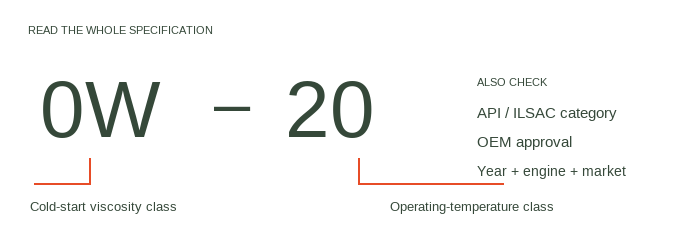
A multigrade label combines a low-temperature W classification with a high-temperature viscosity grade. It does not show two ambient temperatures, oil quality or engine compatibility by itself. Match the full grade and performance requirement in the owner manual.

Read the W portion correctly
The W refers to winter-related low-temperature classification. A lower number indicates a different set of cold-performance limits, not that the oil is only suitable for colder countries. Oils sharing a W classification need not be chemically identical or perform identically at every temperature.
Read the second number separately
The second number identifies the high-temperature viscosity grade. It is not a maximum outside temperature and should not be read as a direct protective-quality score. Choosing a higher number without permission can move the engine outside its intended lubrication requirement. A low-number oil can be the correct engineered choice for an engine designed for it.
Put performance back into the comparison
Viscosity is only one label element. API, ILSAC, ACEA and manufacturer approvals describe other application or performance requirements. Two bottles with the same grade can therefore be intended for different engines. Read the exact product variant rather than treating the brand’s entire range as one oil.
- Find the complete grade in the vehicle manual.
- Keep required approvals in the same shopping note.
- Read allowed alternatives and their conditions.
- Do not average two grades to invent a certified mixture.
Use the label to make fewer guesses
When comparing products, first remove any that lack the required approval or grade. Then compare price and available features among the suitable options. If an engine has a symptom, keep that diagnosis separate from viscosity shopping. A different number on the bottle is not evidence that a mechanical cause has been corrected.
Use a two-axis check when comparing bottles
A useful shopping note has two separate fields: the SAE viscosity permitted by the vehicle and the required performance category or manufacturer approval. Compare each candidate against both fields. Matching the operating-temperature number cannot compensate for a missing approval, and a recognized approval cannot establish that every viscosity in a product family is permitted.
Keep the complete product name in the note so a neighboring grade on the shelf is not substituted accidentally. When reading a data sheet with several grade columns, trace the required claim to the actual column for the bottle in hand. Climate, mileage and a marketing phrase such as performance are reasons to examine the application more carefully, not independent instructions to change the factory viscosity.
Use a two-axis check when comparing bottles
Viscosity and required approval both match
Confirm the exact product and keep its identity with the service record.
Viscosity matches but required approval is missing
Resolve the approval before purchase or use.
Approval family is familiar but grade is not permitted
Use an authorized grade or obtain application-specific factory guidance.
Common questions
Does 0W-20 mean zero degrees to twenty degrees?
No. Those numbers identify different viscosity classifications, not an ambient-temperature range.
Is thicker oil always better?
No. Correct viscosity depends on the engine and manufacturer’s instructions.