Visible bubbles or foam deserve a careful level recheck and review of recent service, but a single dipstick photograph cannot establish the cause. Confirm the reading after the specified wait. Overfill, contamination, or a lubrication fault may require investigation, especially if a pressure warning or noise appears.

Repeat the observation properly
Park level, turn the engine off, and allow the manual's specified measurement conditions to be met. Wipe and reseat the dipstick before reading a clear oil boundary. Distinguish a few surface bubbles from persistent froth throughout the sample. Note whether the engine was just serviced and exactly how much oil was installed. Do not keep running the engine solely to see whether foam returns or disappears.
Check the useful surrounding evidence
A level above maximum, milky appearance, a rising sump level, and recent mixing of fluids each suggest different lines of inquiry. Oil can contain contaminants that cannot be identified visually. If the pressure indicator illuminates while running, stop safely and switch off; foam is not a reason to dismiss that warning. Share photographs and the oil product specification with a technician instead of assuming an anti-foam additive is the answer.
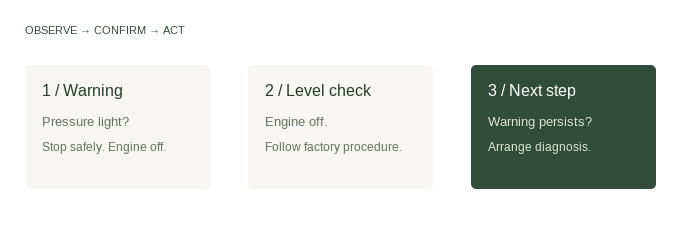
Correct the condition through diagnosis
A confirmed overfill should be reduced using an appropriate procedure before normal use. If coolant or fuel contamination is suspected, find its source and follow the repairer's oil-service advice. A workshop can assess the lubrication system and request analysis when useful. Avoid household remedies or additives that change the oil chemistry. The goal is the specified level and a properly functioning system, not simply a clear-looking dipstick at one moment.
- Record oil product and fill quantity.
- Recheck with consistent waiting conditions.
- Keep pressure warnings separate from appearance.
- Seek assessment for persistent foam or contamination.
Separate surface bubbles from a recurring lubrication concern
Record where and when bubbles are visible. Oil recently poured through a funnel, residue on a dipstick and persistent aeration during normal operation are different observations. Repeat the level check using the exact procedure and note whether the oil is above the marked range. A photograph should describe the checking conditions rather than stand alone as a diagnosis.
Do not deliberately run the engine longer to see whether a suspicious condition becomes worse. If there is a pressure warning, abnormal noise or a confirmed excessive level, stop and arrange assessment. A qualified diagnosis may consider fill level, contamination and application-specific mechanical causes. Oil-analysis results, when relevant, need the sample history and a specific question; bubbles alone cannot establish fuel dilution, coolant concentration or a universal safe limit.
Separate surface bubbles from a recurring lubrication concern
Bubbles appear only after pouring or handling
Recheck under the factory measurement conditions before interpreting the image.
Persistent foaming accompanies an excessive measured level
Arrange correction and diagnosis before normal use.
Foaming accompanies warning or abnormal noise
Stop safely and obtain help.
Common questions
Are a few bubbles always engine damage?
No. Appearance alone cannot establish damage. Persistence, level, warnings, and other findings set the next step.
Can I add anti-foam treatment?
Do not use an unapproved additive as a substitute for diagnosing the level or contamination issue.
