Match three things: the exact engine, the permitted viscosity grade and the required performance specification or manufacturer approval. The owner manual for the correct model year and market is the starting point; a brand name or bottle color cannot establish compatibility.

Identify the vehicle precisely
Find the model year, engine and market version before using an oil finder. A model badge can cover naturally aspirated, turbocharged, diesel and hybrid powertrains with different requirements. Use the vehicle documents, reliable engine identification or manufacturer support to resolve uncertainty.
A VIN-based lookup can help, but check that the result actually identifies the fitted engine and the relevant market. Imported cars, engine swaps and model-year transitions deserve particular care. A retail selector is useful cross-checking information, not permission to ignore conflicting manufacturer instructions.
Read the oil requirement as a complete sentence
The viscosity grade—such as a permitted multigrade—is only part of the requirement. The manual may also specify an API or ILSAC performance level, an ACEA category, or a named manufacturer approval. Two bottles with the same large viscosity numbers can meet different requirements.
Write down the full code and any exceptions. Some manuals permit a temporary alternative when the preferred oil is unavailable, then instruct a return to the preferred grade at a later service. That exception is not a universal upgrade or a rule for another engine.
- Exact model year and engine.
- Required viscosity and permitted alternatives.
- Performance category or manufacturer approval.
- Any market, temperature or service-condition restrictions.
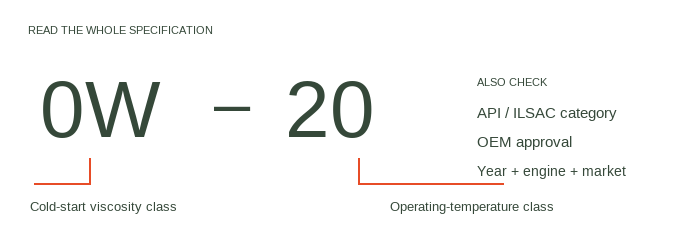
Check the current product label
Read the back label and current product data sheet, not just an old online listing. Product formulations and approvals can change while a familiar brand name remains. Confirm that the exact viscosity variant you are buying carries the required claim; another grade in the same product family may have different approvals.
Distinguish a formal manufacturer approval from a marketer’s statement that a product is recommended for an application. When the vehicle calls for an approval, look for clear evidence of that approval and verify with the oil maker or manufacturer if the wording is ambiguous.
Keep capacity and oil choice separate
Oil capacity answers how much; specification answers which oil. Find the quantity for routine service with the filter operation you are performing. Do not confuse a dry-engine capacity with a service-fill amount. Buy enough for the service and any sensible top-up reserve, but measure the final level rather than automatically emptying every container.
US quarts and liters are not interchangeable units. A quantity copied from another engine or market can create an overfill even when the product itself is correct. Save the required units in your shopping note.
When the available information conflicts
If an oil finder, filler cap and manual disagree, stop and identify the source of the mismatch. The cap may show only the viscosity, the selector may have the wrong engine, or the manual may belong to another market. Ask the manufacturer with the exact engine and year rather than choosing whichever answer is most convenient.
For an urgent top-up, use the manual’s emergency substitution guidance where given. Record the product and quantity added. Do not assume that mixing oils preserves every performance claim, and do not extend the service interval because the top-up bottle advertises long life.
Save the result for future maintenance
Keep a short specification card with the full oil requirement, filter part number, service-fill reference and the correct level-check method. Photograph the selected oil label and retain the receipt. This makes the next service faster and helps another person buy the right top-up oil.
Review the information when the vehicle changes, when a manufacturer issues updated guidance, or when the product label changes. The aim is a repeatable selection process, not loyalty to a single product name regardless of what it currently contains.
Keep the answer specific when comparing search results
A search for an oil type can return several generations, gasoline and hybrid variants, and pages from different sales markets. Save the model year and engine identification beside the viscosity and approval. That makes it easier to reject a plausible-looking answer for a neighboring application.
Use the vehicle-year finder to locate the configuration, then read the application box on the available guide. If the exact combination has no specification article yet, use the manufacturer resource to complete the missing entry. Keep that document with the purchase record so the next service does not start again from a generic brand search.
The information behind an oil answer
| Entry | Record together |
|---|---|
| Vehicle identity | Year, model, engine and market |
| Lubricant requirement | Viscosity and full approval/category |
| Service operation | Oil and filter change or another task |
| Quantity | Service refill reference plus final level procedure |
Common questions
Is the oil cap enough to choose a bottle?
It can help identify viscosity, but may omit performance approvals and permitted alternatives. Check the full manual requirement.
Can I use a newer API category in an older engine?
API describes compatibility within relevant gasoline categories, but retain the required viscosity and any separate manufacturer approval. Newer labels do not make every oil interchangeable.
