A switch should be a normal service using an oil that meets the engine’s required viscosity and approvals. Do not assume you need a flush, a special additive or a longer interval. If the engine already requires synthetic performance, conventional oil is not an equivalent alternative.

Check the destination product
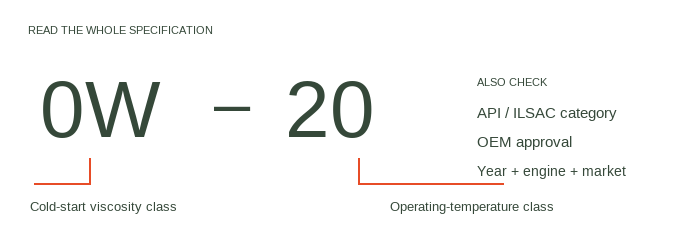
Compare the exact synthetic oil with the manual’s complete requirement. Full synthetic alone is not an approval. Look at the exact viscosity variant and current product data rather than a family name. Resolve any uncertainty about engine identity before purchasing oil or draining the existing fill.
Keep the procedure ordinary
Unless the manufacturer specifically directs otherwise, do not invent a transition flush or mix several additives to prepare the engine. Follow the proper oil and filter service procedure. Existing leaks or contamination need assessment on their own merits; a product switch does not identify or repair their cause.
Retain a clear service schedule
Use the vehicle’s applicable time and mileage limits or oil-life guidance. A new synthetic bottle’s extended-use claim may have conditions and does not automatically override the manufacturer. Record the date, odometer, oil and filter, then reset the reminder only when the complete service is finished.
- Verify viscosity and approval.
- Avoid unnecessary flushing chemicals.
- Fit the correct filter and seals.
- Recheck the level using the vehicle procedure.
Switching back needs the same checks
There is no useful universal promise that every engine can switch back to any conventional oil. The alternative still must satisfy the engine requirement. If suitable conventional products do not meet that requirement, the cost comparison is irrelevant. Compare actual compatible products and use a documented service baseline for either direction.
Common questions
Will synthetic oil automatically cause a leak?
Do not assume a universal outcome. Inspect actual leaks and use an appropriate product rather than treating a formulation label as a diagnosis.
Do I need an engine flush first?
Only use a flushing procedure when supported for the vehicle and situation.