Engine oil is already formulated with an additive system. Do not add a separate supplement, thickener or flush simply because it promises extra protection. Check the vehicle’s guidance and investigate any actual symptom before changing the oil’s composition.

Identify the problem you want to solve
A service reminder calls for maintenance; a leak or pressure warning calls for assessment; ordinary product selection calls for matching specifications. These situations should not all lead to a bottle of additive. Record the observation and use the correct diagnostic path rather than choosing a product first and assigning it a problem afterward.
Respect the complete formulation
A compliant oil’s base oils and additive package are designed as a system. Adding a supplement creates a different mixture whose performance cannot be assumed from the original label. A claim about one ingredient is not proof of compatibility with every engine, seal, filter or exhaust-treatment system.
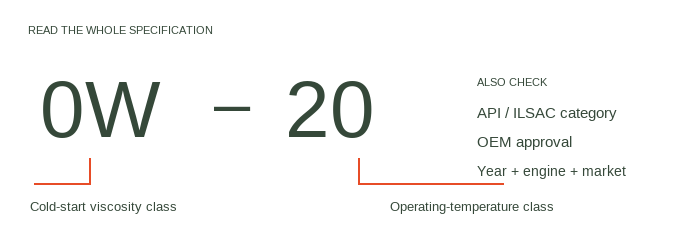
Read any manufacturer restriction
Check whether the vehicle prohibits supplemental additives or specifies an approved procedure for a particular repair. A workshop-directed cleaning operation is different from routine home dosing. Do not copy a chemical treatment from another engine or use a higher dose on the assumption that more must work better.
- Choose correct oil before buying supplements.
- Do not treat viscosity additives as diagnosis.
- Check product and vehicle instructions together.
- Keep unusual treatments documented.
Use evidence when a treatment is proposed
Ask what condition was found, how the proposed procedure addresses it, and what follow-up verifies the result. If there is no identified problem, ordinary correct maintenance may be the appropriate action. Stop and obtain qualified help for urgent warnings rather than continuing to run the engine while testing an additive claim.
Common questions
Can an additive replace an oil change?
No. It does not complete the scheduled oil and filter service.
Should I flush every engine before switching oil?
No universal flushing requirement follows from a product switch. Use approved vehicle-specific guidance.
Should I tell a workshop about an additive already used?
Yes. Record the product, amount and date, and provide that information during diagnosis. An accurate history is more useful than leaving the workshop to assume the sump contains an unmodified known oil.