A parked-car stain shows where fluid landed, not necessarily where the leak began. Note the parking duration, location, engine temperature, and changing fluid levels. Small drips can migrate across an undertray, while a growing puddle or warning message needs urgent assessment.

Make the parking pattern repeatable
Choose a level parking area where a leak can be contained safely. Mark the orientation on a clean sheet of cardboard and record when the car arrived. Compare a short stop after driving with an overnight cold park. The comparison can help a workshop reproduce the problem, but do not keep operating the engine solely to create a stain. If a shared driveway has multiple vehicles, confirm that the spot belongs to your car.
Follow fresh oil rather than old grime
From above, inspect the cooled engine around accessible gasket edges, the filler opening, and the filter area. Dusty oil residue can be old; a shiny wet trail or a fresh droplet provides a more useful lead. Oil may run to the back of the engine, pool on a guard, or blow along the underside while driving. Do not assume a rear-main-seal repair simply because a drip lands near the transmission.
Decide whether the car should move
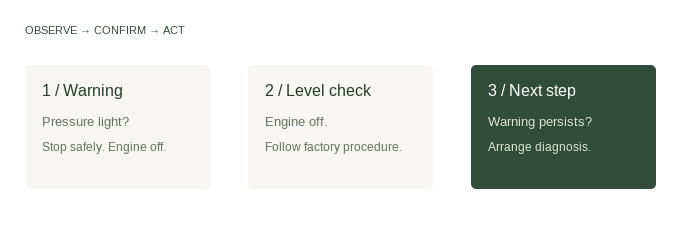
Check the dipstick or electronic level as the manual specifies. A stable level and slight dampness are different from an active stream, but a remote visual description cannot establish driving safety. Oil contacting exhaust parts, slipping onto brakes, or accompanied by smoke or pressure warnings needs prompt shutdown and help. Give the workshop the stain log and photographs so it can begin with evidence rather than replacing the most convenient gasket.
- Record cold versus recently driven parking.
- Measure top-ups rather than estimating them.
- Contain the leak without rinsing it into a drain.
- Keep hands away from belts and hot surfaces.
Common questions
Why is there no stain while driving?
Air movement and undertrays can carry or retain oil. The absence of a driving stain does not prove the leak stops.
Does a stain prove an engine-oil leak?
No. Confirm fluid identity through location, reservoir checks, and inspection; color alone is insufficient.