GM states that dexosR oils can serve gasoline engines previously using dexos2 or dexos1 Gen 2 or Gen 3 when the appropriate viscosity is used. That does not authorize switching a vehicle to whichever dexosR grade is easiest to find.

What the current GM notice establishes
The dexosR licensed-brand page contains an explicit gasoline-engine compatibility statement. The dexos1 Gen 3 page also directs earlier dexos1 applications toward Gen 3 or dexosR in the appropriate grade. This is stronger evidence than assuming that a later-looking label must replace every earlier one.
Keep the conditions attached to the statement. Its gasoline-engine scope is important, and the viscosity condition remains part of the permission. A compatibility statement about an approval does not rewrite the rest of the vehicle handbook.
Why the grade can stop a substitution
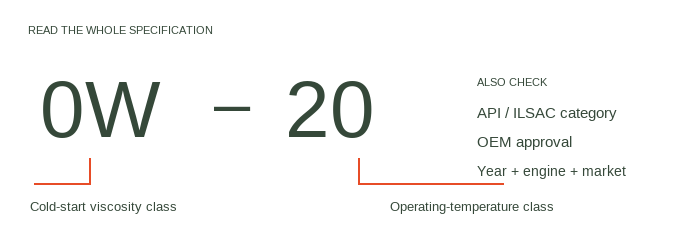
An owner searching for a required 0W-20 may encounter dexosR bottles in a different grade. The correct response is to check whether the proposed product satisfies every applicable requirement. Do not change viscosity simply to move to another specification family.
The current dexosR list shows product-specific grades, including 0W-40 and 5W-50 entries. Treat that as a catalog of licensed products rather than a menu of grades permitted in one engine. Verify the current list when buying because product names and availability can change.
A practical comparison at the parts counter
Write the exact original requirement on a note, then compare the proposed bottle with it in two columns: approval compatibility and permitted viscosity. If either entry is uncertain, pause the purchase and obtain application-specific confirmation. This is especially useful when store software suggests a performance oil based on a broad model-family match.
For a shop quote, ask for the actual product and viscosity before comparing prices. A more expensive bottle is not automatically a better match. The service should also include the correct filter, seals, refill verification and any separate severe-use requirement.
Keep street and performance-use instructions distinct
Some vehicles have additional procedures or oil choices for particular operating conditions. A statement that a licensed oil may be suitable does not establish a track-use interval, a track preparation procedure or permission to ignore a service reminder. Use the vehicle-specific instructions for the actual activity and keep the record of what was installed.
- Check the current GM compatibility note.
- Preserve the correct engine and fuel-type scope.
- Match the viscosity permitted for that application.
- Do not import another vehicle’s performance-service instructions.
A proposed dexosR substitution
| Question | Proceed when | Pause when |
|---|---|---|
| Application | The current guidance covers this gasoline application | The engine or fuel-type scope differs |
| Viscosity | The grade matches the permitted requirement | Only an unsupported grade is available |
| Product | The exact product is licensed | Only a brand-level or retail claim is available |
Common questions
Do I have to abandon dexos1 Gen 3 whenever dexosR exists?
The current GM Gen 3 list remains available. Match the vehicle requirement and current GM guidance; the existence of another licensed family does not force an unsupported viscosity change.
Does this substitution rule cover a light-duty diesel?
The cited dexosR statement is for gasoline engines. GM gives separate diesel replacement guidance on the dexosD and dexos2 pages.