GM identifies licensed dexos oils by the dexos marking and an 11-character alphanumeric license number. Verify that number together with the exact product name, viscosity and specification in GM’s official licensed-brand list.

Start with the specification your engine requires
Find the exact engine and the applicable handbook entry before opening a licensing database. A valid license proves something about a particular product; it does not establish that your vehicle requires that approval. Keep the required viscosity and specification beside you while searching.
GM provides separate pages for dexos1 Gen 3, dexosD and dexosR, with a legacy dexos2 page and replacement notice. Selecting the correct page first avoids confusing similar product names across gasoline and diesel applications.
Match four pieces of product information
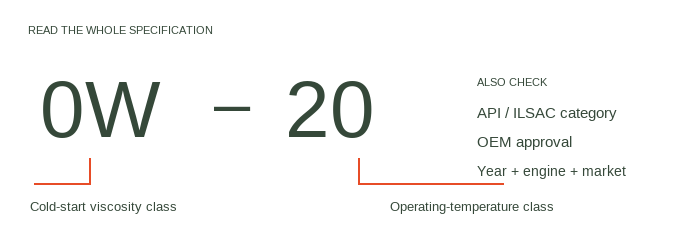
Use the product name, stated specification, viscosity and license number as a combined match. Also note the supplier when comparing rows. The same brand can have several formulations, while a manufacturer may supply products under more than one label. A familiar logo alone is not enough detail for a careful comparison.
For example, the current dexosD list includes Mobil 1 ESP X2 0W-20 with license DD40BCCB015. That is a dated example checked on October 26, 2026, not a recommendation for every engine. A bottle bearing another product line or grade needs its own match.
What to do when a search does not match
Check transcription first, especially zero versus the letter O, spaces and a partial product name. Then confirm that you are reading the actual container rather than a generic seller photograph. Retail images can show an older label or a neighboring grade.
If a mismatch remains, retain the label photo and ask the oil supplier or GM for clarification before using the product. A failed text search does not by itself prove counterfeiting. It does establish that the intended license verification is incomplete, which is a reason to choose a clearly documented alternative.
Save evidence that remains useful later
Record the full product name and grade on the maintenance receipt. A photograph of the front and back labels helps identify a reformulated or renamed product later. Save the source link and checking date with the record instead of treating a search result as permanent certification.
For a bulk-oil shop, request the supplier product identifier and current technical data sheet. Ask the shop to state the required approval on the work order. This makes a later comparison about the actual oil installed rather than the color or branding of a dispenser.
- Confirm the vehicle’s required specification first.
- Match the exact product and grade in the correct GM list.
- Resolve an unexplained mismatch before pouring.
- Keep the product identity with the service record.
The four-part license match
| Field | Where to read it | What to retain |
|---|---|---|
| Product and supplier | Container and GM list | Full name, not only brand |
| Specification | Required manual entry and GM list | dexos family |
| Viscosity | Container and applicable list row | Exact SAE grade |
| License | Container and GM list | Complete alphanumeric identifier |
Common questions
Does “suitable for dexos applications” prove a GM license?
GM distinguishes licensed products from unlicensed claims. Verify the actual marking and license entry; do not substitute a seller’s broad description for that check.
Can a listed brand use the same license for every viscosity?
Verify the product’s own record. The official lists include grade-specific entries, so one licensed bottle does not establish the status of its whole brand.