Re-refining processes used oil into base stock for new lubricant production. Choose a finished product that meets the engine’s required viscosity and approvals. Re-refined does not mean pouring filtered used drain oil back into the engine.

Separate a finished product from used oil
Used engine oil can contain contamination and is collected for controlled processing. A properly manufactured re-refined lubricant is a new finished product made through an industrial process. Home filtering or letting used oil settle is not equivalent to that process and cannot establish engine-oil performance.
Apply the same purchasing standard
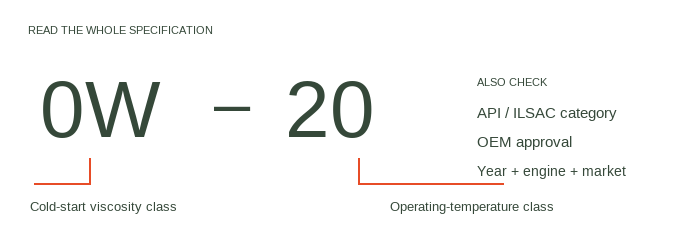
Read the current product label and data sheet for viscosity, categories and required manufacturer approvals. Environmental claims are useful context, but they do not replace application compatibility. A re-refined product should be evaluated by its finished specification in the same disciplined way as another oil.
Keep service intervals unchanged unless directed
The origin of the base stock does not independently set the oil-change interval. Use the vehicle schedule, correct filter and operating-condition rules. Record the exact product so future top-ups and service discussions do not rely on the broad description recycled oil.
- Look for a clearly identified finished lubricant.
- Match the complete required specification.
- Do not reuse home-filtered drain oil.
- Continue normal service and level checks.
Close the recycling loop carefully
Return used oil through an approved local collection route and keep it separate from other waste fluids. Ask about filter acceptance as well. Collection does not guarantee every batch becomes new engine oil; recycling routes vary. The practical contribution is clean segregation and responsible handoff, followed by specification-based purchasing.
Common questions
Is re-refined oil the same as old oil with dirt removed?
No. Industrial re-refining and finished-oil formulation are different from a simple home filtration step.
Can I use it in any car?
Only when the finished product meets that car’s complete requirement.
Does recycling every bottle mean it becomes the same product again?
No. Collection and processing routes vary. Keep used oil segregated and hand it to an approved collection route; evaluate any new lubricant by its finished specification rather than assuming a particular recycling outcome.
